
Enhancing Emergency Preparedness with NFC & QR Tags
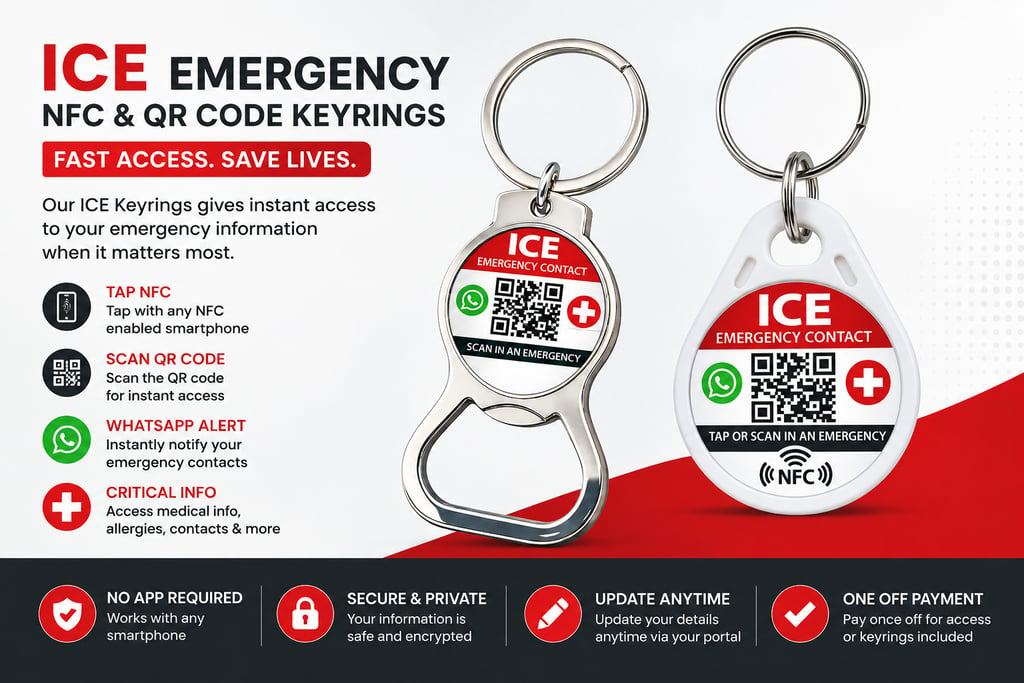
Our ICE Emergency NFC & QR Tags are designed to give you fast and secure access to important emergency information when it matters most. Whether for personal use, schools, sports teams, elderly care, or businesses, we offer a simple once-off setup process tailored to your needs. We first discuss how many tags you require and how you would like to use the system. You can choose between digital profile access only or physical NFC & QR keyrings included with your setup.
MEDICAL IN CASE OF EMERGENCY
Understanding the Importance of ICE Tags
In emergency situations, rapid and precise access to critical information can significantly influence outcomes for individuals in need of assistance. This is where ICE (In Case of Emergency) tags serve as an invaluable resource. These tags provide a streamlined approach to relay essential information, including emergency contacts, medical conditions, allergies, and specific instructions, all of which can be crucial during a medical crisis.
ICE tags are designed for easy accessibility, commonly worn as bracelets, necklaces, or stored in wallets. When first responders or medical personnel encounter an individual in distress, they can swiftly locate these tags, gaining immediate insights into the person's health status and preferences, thereby facilitating timely and appropriate care. This becomes particularly critical when the affected individual is incapacitated and unable to communicate their needs directly.
Various scenarios highlight the necessity of having ICE tags. For instance, individuals with chronic health conditions, such as diabetes or heart disease, should carry ICE tags to ensure healthcare providers can deliver the appropriate treatment swiftly. Families traveling together or those with young children can also benefit from ICE tags, as they ensure the availability of important health information regardless of location. Similarly, organizations, such as schools or workplaces that cater to a diverse demographic, can implement an ICE tagging system to safeguard the well-being of both students and employees.
In conclusion, ICE tags play a fundamental role in enhancing emergency preparedness. By providing immediate access to vital information, these tags can bridge significant communication gaps and potentially save lives. Their adoption across various settings not only empowers individuals to take control of their health but also aids emergency personnel in delivering effective, timely assistance.
Choosing the Right Setup for Your Needs
When enhancing emergency preparedness with NFC and QR tags, selecting the appropriate setup is essential for ensuring optimal efficiency and accessibility. The initial step in this process involves determining the necessary number of ICE (In Case of Emergency) tags based on personal or organizational requirements. Each tag can store digital profiles containing important information, thus making it essential to assess the quantity needed to cover all individuals who may require assistance during an emergency.
In addition to the number of tags, customization significantly impacts the effectiveness of these systems. Users can opt for digital profile access through NFC or QR codes, allowing authorized personnel to retrieve essential medical information promptly. This option is particularly advantageous for individuals with specific medical conditions or allergies, as it enables first responders to be informed instantly. Moreover, a digital profile can be updated regularly, ensuring that the information remains current and accurate over time.
Conversely, combining physical NFC and QR keyrings can provide tangible reminders for users to carry essential data. These physical tags are particularly beneficial for individuals who may not be technology-savvy or for family members who prefer a straightforward approach to accessing critical information. In situations where individuals may not have their phones or the battery has died, these physical keyrings can serve as reliable backups.
Ultimately, the decision should center around identifying the unique needs of the intended users. Factors such as lifestyle, frequency of travel, and personal comfort with technology ought to inform this choice. Assessing these elements will assist in determining the best configuration for individuals or organizations to achieve optimal emergency readiness.
The Setup Process: From Quotation to Delivery
Establishing your NFC or QR tags for emergency preparedness begins with obtaining a tailored quotation, a critical first step in customizing your Individualized Critical Emergency (ICE) profile. This process typically starts with an evaluation of various service providers and requests for quotes that align with your requirements and budget. Many companies offer online forms or consultation services, enabling you to articulate your specific needs regarding the emergency preparedness tags. Upon receiving your quotation, it is essential to review the available options for tag designs and functionalities.
After selecting a provider and finalizing your design, the next step is to confirm your order. This confirmation phase often involves establishing secure access to your ICE profile. Providers typically offer an intuitive interface, enabling you to create and manage your profile effectively. During this setup, you will be guided through the input of crucial information, such as emergency contacts, medical conditions, and any special instructions. Ensuring the accuracy of this information is vital, as it can profoundly impact responses during emergencies.
If custom keyring designs are requested, this is the stage where collaboration with the design team can lead to further personalization of your tags. Customization might include selecting colors, fonts, or adding logos that reflect your identity or organizational branding. Once all details are finalized, the production of your ICE tags will commence. While awaiting delivery, many providers offer various options to receive your tags, including nationwide courier services for convenience or personal delivery for local customers. This user-friendly approach ensures that your emergency preparedness tags are delivered promptly, ready for immediate use.
Accessing and Managing Your Emergency Information
Accessing and managing your emergency information through NFC and QR tags is designed to be both straightforward and efficient, ensuring that critical data is readily available during emergencies. With the implementation of Near Field Communication (NFC) and Quick Response (QR) codes, individuals can quickly access their emergency information without the need for any specialized applications. Simply tapping an NFC-enabled device or scanning a QR code with a standard smartphone camera instantly grants access to the information stored in an In Case of Emergency (ICE) profile.
The types of information that can be included in an ICE profile are vital. Medical history, including chronic conditions and medications, can significantly influence treatment decisions during emergencies. Notably, details regarding allergies—whether to medications, food, or environmental factors—should be prominently included to prevent adverse reactions. Additionally, emergency contacts, such as family members or close friends, should be listed to ensure rapid communication in urgent situations.
Maintaining updated information is crucial for the efficiency of the ICE tag. As medical conditions can change and new allergies may develop, regularly reviewing and updating this data ensures that first responders have access to accurate information. It may be beneficial to set reminders for oneself to periodically review this information, reinforcing the importance of preparedness. Furthermore, sharing updated information with family members can enhance their ability to support individuals in an emergency.
Thus, the integration of NFC and QR codes into emergency preparedness plans enhances accessibility while providing peace of mind. With a simple tap or scan, users can confirm that relevant, up-to-date medical information is available at a moment's notice, facilitating timely and effective responses in critical situations.